Combining natural solid timber with modern high-polymer resin allows furniture designers to create breathtaking, organic statement pieces for corporate boardrooms and luxury hospitality interiors. However, from a structural engineering standpoint, fusing these two distinct materials involves managing a continuous physical conflict.
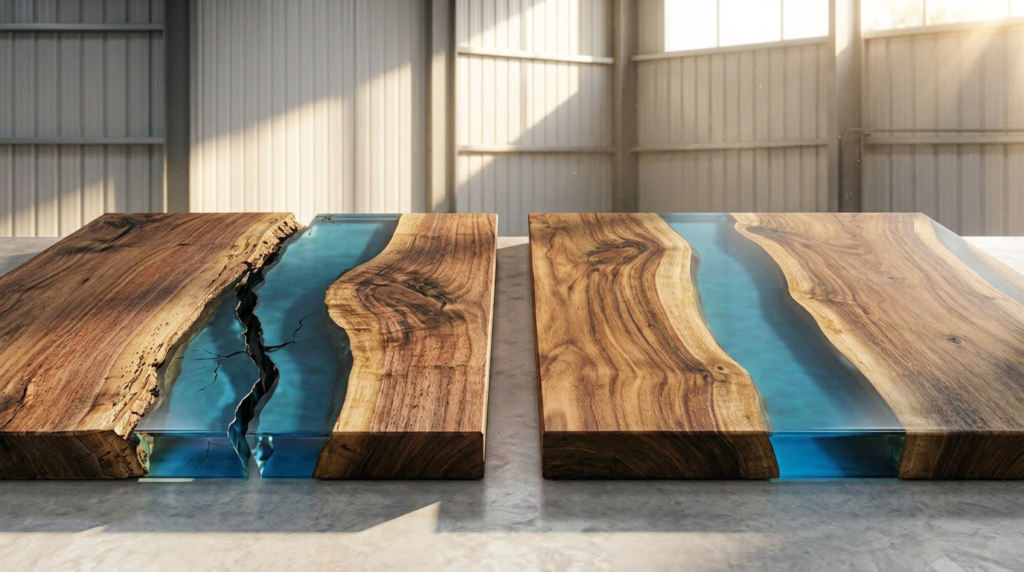
Natural wood is an anisotropic, hygroscopic material—it constantly breathes, expanding and contracting based on ambient atmospheric humidity. On the other hand, industrial resin transforms into a completely rigid, non-porous solid once fully cured. If a manufacturer fails to balance the physical stress between these two materials during fabrication, the joint where timber meets polymer will eventually split, shear, or separate after being exposed to overseas climate changes.
At Huizhou Xinyi Art Co., Ltd., we eliminate the risk of joint delamination long before the casting process begins. Backed by our 23 years of specialized B2B contract manufacturing, we utilize strict material stabilization and chemical bonding protocols to ensure our hybrid furniture withstands decades of environmental fluctuations.
The 8% Moisture Content Rule: Eliminating Volumetric Wood Movement
The most common root cause of resin table failure is insufficient wood drying. Many standard workshops utilize air-dried lumber or improperly conditioned slabs with an internal moisture content (MC) exceeding 15%. When these finished tables are exported to regions with heavy interior heating or lower seasonal humidity, the wood rapidly sheds its internal moisture, shrinks, and tears away from the resin matrix.
Our facility neutralizes this hazard through a rigorous raw material preparation sequence:
Extended Kiln-Drying: Every wood slab, whether premium black walnut or exotic live-edge timber, undergoes an extensive kiln-drying and conditioning cycle to stabilize its cellular structure.
Core-Moisture Verification: Before entering the production line, our quality control team uses invasive pin-type moisture meters to verify that the core moisture of the timber is locked precisely between 6% to 8%—the universal golden standard for premium international furniture export.
Deep-Penetration Sealing: Creating an Inseparable Mechanical Interlock
Simply pouring liquid resin directly against a raw, untreated wood edge results in a superficial bond. The natural oils and loose micro-fibers on the timber surface prevent the polymer from achieving deep chemical adhesion, making the joint highly susceptible to structural stress.
To establish an unbreakable connection, our craftsmen execute a multi-layer deep-penetration sealing process:
Micro-Surface Preparation: The live edge of the wood is thoroughly cleaned, debarked, and mechanically profiled to expose the open grain.
High-Adhesion Epoxy Priming: We apply a specialized, low-viscosity, high-penetration modified epoxy primer directly to the wood fibers.
This primer acts as a bridge, soaking deep into the microscopic pores of the timber wood cells. When the main structural resin is poured later, it chemically fuses with this primer layer, creating a permanent, unified mechanical interlock that cannot be separated by natural wood movement.
Exothermic heat generation is another critical risk factor in large-scale resin casting. When pouring resin sections that are 5cm to 10cm thick, a rapid chemical reaction causes the liquid to heat up too quickly. This thermal spike leads to severe uneven volumetric shrinkage, trapping massive internal stress (or hidden microscopic fractures) inside the table. Even if the table looks perfect upon exiting the workshop, these hidden stress points act as a ticking time bomb that will crack under minor temperature shifts.
We dissipate this internal tension by enforcing managed multi-stage pouring schedules:
Layered Volume Optimization: We calculate the exact mass-to-volume ratio for every custom tabletop size, pouring the resin in precise, controlled thickness layers.
Climate-Controlled Curing Room: The tables cure slowly inside our specialized, climate-controlled rooms where ambient temperatures are kept perfectly constant. This allows the polymer chains to cross-link calmly and uniformly, completely eliminating residual internal stress.
Built for Global Environments
High-end contract furniture must be engineered to perform flawlessly anywhere in the world, from humid coastal resorts to dry, climate-controlled corporate offices. By combining scientific timber conditioning with advanced polymer stress management, Huizhou Xinyi Art delivers structural reliability that matches our aesthetic craftsmanship.
Do you have an upcoming commercial interior project or custom boardroom furniture RFQ that requires durable, high-specification execution? Contact Huizhou Xinyi Art Co., Ltd. today to review your project blueprints with our technical team.
Discover our direct factory production workflow for custom high-clarity resin furniture and sculptures. From CAD engineering to zero-bubble casting and 7-stage hand polishing
Engineering specification guidelines for mitigating shrinkage alignment errors and structural variance during the B2B custom resin prototyping and physical sampling phase.
 Huizhou Xinyi Art Co., Ltd.