For global contract furniture buyers, hospitality procurement managers, and luxury brand designers, sourcing custom resin furniture or large-scale display components from overseas is a high-stakes gamble.
When you fly into China or hire a third-party inspector (like SGS or TUV) to audit a potential factory partner, it is incredibly easy to get blinded by a glamorous, multi-million-dollar showroom. Glossy samples, flawless lighting, and polished sales pitches can make any supplier look like an industry giant.
But here is the hard truth of the resin industry: Showrooms lie. Workshops tell the truth.
A resin dining table or a batch of 6,000 resin perfume bases might look immaculate under showroom spotlights. But if the workshop floor lacks rigorous technical engineering, that same resin will warp, crack, or turn a nasty shade of yellow within six months of arriving at your commercial project site.
If you want to protect your project deadline and your client’s budget, bypass the showroom. Walk straight onto the factory floor and audit these three critical technical indicators.
1. The Micro-Climate Check: Look for the Thermo-Hygrometer
High-end, commercially viable resin casting is not just craftsmanship; it is precise chemical engineering. Thermosetting polymers are deeply sensitive to the environment during their liquid-to-solid transition phase.
When walking through a pouring workshop, do not just look at the size of the slabs. Look at the walls for industrial thermo-hygrometers and climate control systems.
The Technical Benchmark: The pouring and initial curing zones must maintain a stable temperature of 20°C to 25°C and a relative humidity strictly below 60%.
Why It Matters: If a workshop is exposed to ambient outdoor weather—facing drafts, seasonal humidity spikes, or shifting room temperatures—the chemical cross-linking of the resin will destabilize. Moisture trapped in the air will react with the curing agent, creating microscopic bubbles (micro-voids). Under the high-stress conditions of ocean freight shipping or intense commercial usage, these hidden micro-voids will rapidly turn into structural cracks.
If a factory cannot show you a dedicated, temperature-controlled, dust-isolated curing room, they are running a low-end workshop, not a commercial-grade manufacturing facility.
2. Workspace Transparency: Check Worker PPE and Air Filtration
For modern global buyers, ESG (Environmental, Social, and Governance) compliance isn’t just a buzzword—it is a major operational insurance policy. A factory that operates in violation of basic environmental and occupational safety laws is a factory that could be instantly shut down by local authorities right in the middle of your production run.
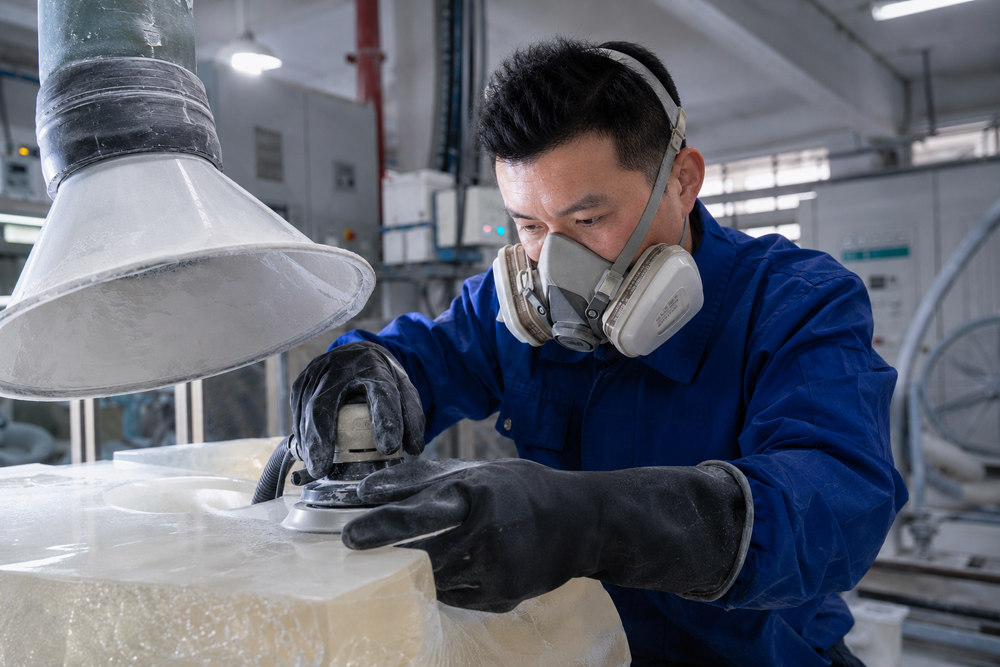
When inspecting the grinding and shaping zones, look closely at the craftspeople.
The Technical Benchmark: Every operator handling raw resin pouring, cutting, or rough sanding must be equipped with professional-grade personal protective equipment (PPE)—specifically, multi-layer particulate respirators (such as 3M dual-cartridge masks) and heavy-duty nitrile barriers. Furthermore, each workstation must feature active, high-volume localized dust extraction hoods.
Why It Matters: The dust generated from sanding cured epoxy or acrylic is incredibly fine and hazardous if inhaled without proper filtration. A factory that protects its workforce with proper ventilation and masks is a factory built for long-term compliance and stable, uninterrupted lead times. If you see workers unprotected on a dusty, unventilated floor, you are looking at an unsafe operation that poses a massive supply-chain risk to your business.
3. The Surface Integrity Audit: Demand the 7-Stage Physical Polishing Protocol
Many low-tier factories cut production times in half by taking a dangerous shortcut: they sand the resin surface up to a mediocre 3000-grit, and then spray a thin, clear chemical varnish or polyurethane topcoat over the table to simulate a high-gloss finish.
In a showroom, a sprayed-on clear coat looks perfectly fine. In the real world, it is a ticking time bomb. Within months of commercial wear and tear, that chemical coating will scratch easily, lift, peel, or turn yellow due to UV exposure.
The Technical Benchmark: Ask the workshop master technician (Shifu) to show you their exact sanding sequence. A top-tier manufacturer relies strictly on a 7-Stage Physical Polishing Protocol. The surface must be progressively worked through mechanical grits ranging from a coarse 120-grit all the way up to an ultra-fine 5000-grit or 8000-grit, followed by a cold-buffing compound.
Why It Matters: True liquid-crystal clarity and scratch-resistance must be built into the resin material itself through exhaustive physical friction, not achieved via a temporary spray-on chemical illusion. Pure physical polishing ensures that the surface remains optically clear for a decade and allows the material to retain its intrinsic self-healing properties against minor surface micro-scratches.
The Ultimate Sourcing Takeaway
Choosing a manufacturing partner based solely on a catalog or a showroom walkthrough is a recipe for project delays and quality disputes. The next time you audit a custom resin factory, demand transparency where it actually matters. Look at the thermometers, inspect the ventilation, and audit the grit sequences on the factory floor.
At Huizhou Xinyi Arts Co., Ltd. (xyresin.com), we keep our workshop doors open because our technical engineering is our greatest asset. We do not just build high-end resin furniture and brand displays; we manufacture peace of mind for global buyers.
Confused about materials? Read the quick guide by Huizhou Xinyi Art Co., Ltd. Compare stainless steel, fiberglass, bronze, and stone for outdoor fountains and sculptures.
Elevate your hotel lobby with custom resin art reception desks. Discover why top designers like ABLE / VIP Saloti choose Huizhou Xinyi Arts for high-end, durable, and one-of-a-kind commercial furniture solutions. Explore our hospitality projects t...
Discover how bespoke glowing resin bar tops elevate modern bars and nightclubs. High-impact visuals, tactile luxury, and commercial durability for high-traffic venues.
 Huizhou Xinyi Art Co., Ltd.