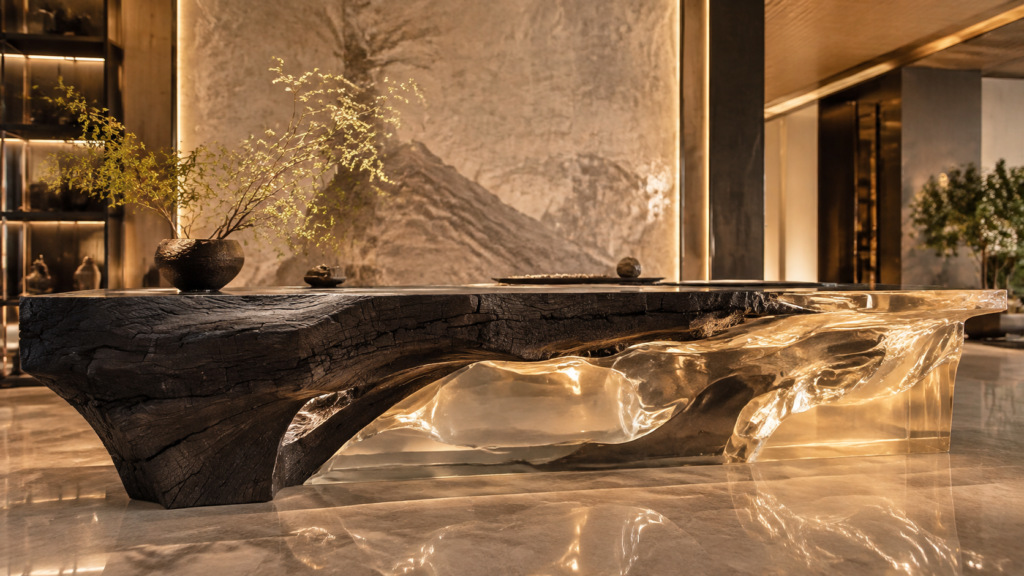
In modern luxury hospitality and architectural developments, the synthesis of organic, raw elements with highly engineered synthetic polymers creates a striking visual and tactile contrast. Among these hybrid formulations, the integration of Shou Sugi Ban (Yakisugi)—the traditional Japanese technique of surface timber carbonization—with clear epoxy resin has emerged as a high-demand aesthetic for bespoke reception desks, feature walls, and dining surfaces.
However, casting liquid resin directly over deeply charred wood introduces severe chemical and physical challenges: carbon dust contamination, trapped micro-gases, unreacted wood oils, and compromised structural adhesion.
At Huizhou Xinyi Art Co., Ltd., our engineering team has standardized the material preparation protocols required to achieve long-term structural integrity and optical clarity when fusing carbonized timber with liquid polymer matrices. Below is an overview of these technical controls.
1. Thermal Carbonization Depth and Loose Ash Remediation
The primary failure point in timber-polymer fusion occurs at the loose carbon boundary layer. Unstabilized char acts as a barrier, preventing the resin from reaching the solid wood grain beneath.
Controlled Surface Pyrolysis: Timber specimens (typically Cedar or Accoya) undergo surface burning at temperatures between $600^\circ\text{C}$ and $800^\circ\text{C}$ to form a dense, alligator-skin charcoal layer ($1\text{ mm}$ to $3\text{ mm}$ in depth).
Mechanical Brushing & High-Pressure Ablation: Excess, unbonded soot and loose ash are removed using stiff brass wire brushes, followed by high-pressure dry compressed air ($6\text{ bar}$) to flush fine soot particles from deep grain fissures.
Char Stabilization Priming: Prior to full encapsulation, an ultra-low viscosity ($<150\text{ mPa}\cdot\text{s}$), high-penetration resin sealer is sprayed or brush-applied. This locks the carbonized scales in place, preventing loose soot particles from floating into the main resin pour and clouding the matrix.
2. Degassing and Outgassing Mitigation in Porous Structures
Charred wood is inherently hyper-porous. When liquid resin covers the timber, exothermic heat causes air trapped inside the cellular structure of the wood to expand and vent into the resin, creating persistent micro-bubbles along the wood-resin interface.
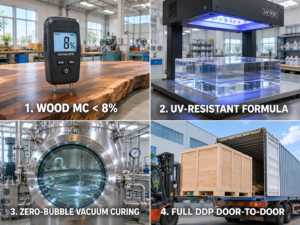
Timber Moisture Content (MC) Standardization: Wood must be kiln-dried to a strict Moisture Content of $6\%\text{–}8\%$ prior to carbonization. Excess moisture reacts negatively with polymer curing agents, causing hazing or incomplete cross-linking.
Vacuum Sealing and Pre-Encapsulation Coating: The carbonized timber undergoes a two-part sealer coat in a controlled environment. The sealer penetrates the microscopic pores, effectively sealing off all pathways for moisture and gas escape.
Sub-Atmospheric Degassing: During the primary pour, the assembled mold containing the sealed timber is subjected to a vacuum chamber pressure drop ($<-0.095\text{ MPa}$) to draw out any remaining air pockets from deep fissures before the resin begins its gelation phase.
3. Interfacial Adhesion and Exothermic Heat Management
The thermal expansion coefficient of natural wood differs significantly from cured thermosetting resin. Furthermore, deep-pour resin castings required for commercial furniture generate substantial exothermic heat during curing, which can crack the charred timber layer if unmanaged.
Low-Exotherm Polymer Formulations: Deep-pour epoxy systems with extended pot life ($12\text{–}24\text{ hours}$) are selected. Maintaining peak exothermic temperatures below $50^\circ\text{C}$ during cure prevents internal thermal shock, preserving the structural integrity of both the wood and the carbon layer.
Chemical Interlocking: By preserving the deep 3D topography of the burnt wood surface, the resin achieves both chemical bonding and deep mechanical keying, ensuring the finished slab withstands structural deflection and ambient humidity fluctuations in high-traffic commercial spaces.
Summary for Architectural & Engineering Specifications
When specifying Shou Sugi Ban resin components for commercial BOQs, performance relies entirely on pre-casting timber stabilization and controlled curing dynamics rather than superficial encapsulation.
As a dedicated manufacturer of premium resin art decor and artistic furniture, Huizhou Xinyi Art Co., Ltd. integrates these rigorous engineering controls across all custom fabrication projects. Proper execution guarantees a seamless, maintenance-free surface that retains the raw beauty of burnt timber protected under a high-impact, UV-stable polymer shield.
Engineering specification guidelines for mitigating shrinkage alignment errors and structural variance during the B2B custom resin prototyping and physical sampling phase.
Discover how custom translucent resin ocean wave sculptures elevate ocean parks and playgrounds. Engineered for high-traffic commercial durability by Huizhou Xinyi Art.
Streamline your supply chain. Learn how Huizhou Xinyi Art handles everything from blueprint fabrication to complete DDP customs clearance and jobsite delivery.
 Huizhou Xinyi Art Co., Ltd.