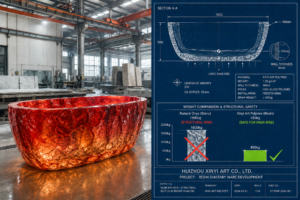
For decades, natural translucent stones like Onyx and rare aesthetic quartzites were the default choice for luxury backlit features in hospitality interiors. However, as global architectural trends lean toward organic minimalism and seamless geometric fluid forms, natural stone is hitting its structural limitations.
Forward-thinking interior architects are shifting their specifications toward engineered high-polymer liquid resin. This isn’t about cost-cutting; it is a deliberate transition driven by performance, scale, and design freedom.
Here is a technical comparison of why advanced resin casting is defining the future of high-traffic commercial focal points:
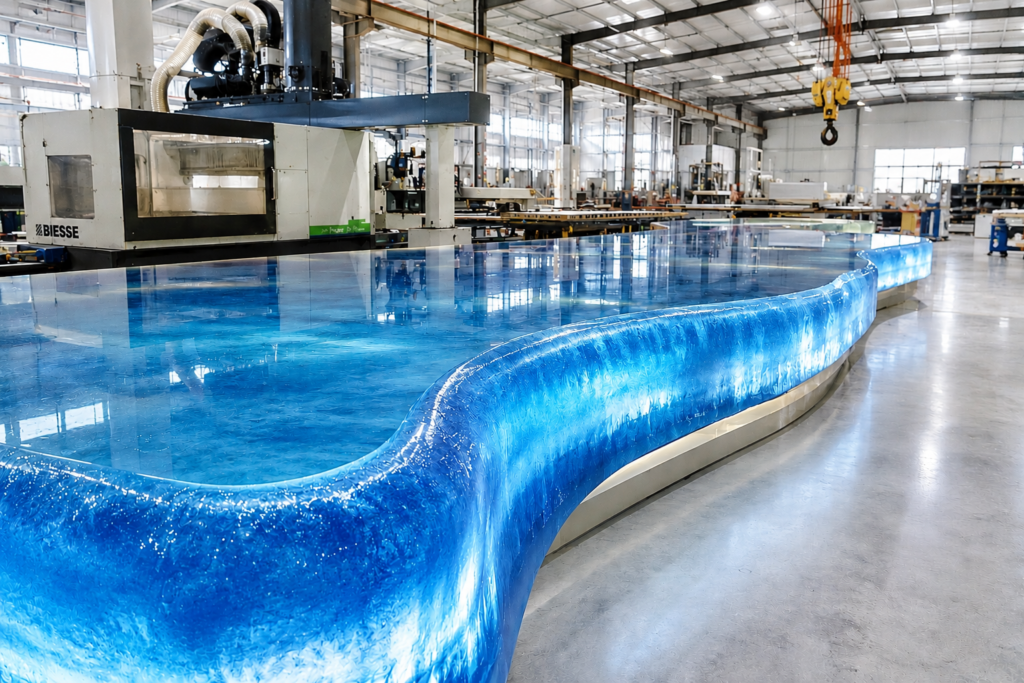
1. Eliminating Structural Seams at Macro Scale Natural stone slabs are constrained by geological quarrying limits, rarely exceeding 3 meters. For a 5-meter or 8-meter continuous bar counter, architects are forced to accept prominent epoxy joint lines that disrupt veining patterns.
The Material Evolution: Liquid resin allows for monolithic solid casting. Complex, undulating curves and massive spans can be executed with zero visible structural seams, maintaining a completely continuous fluid aesthetic that natural stone cannot physically replicate.
2. Precision Translucency Control vs. Geological Lottery When specifying natural backlit stone, designers are at the mercy of natural flaws, unpredictable mineral densities, and internal iron deposits that create dirty shadows or uneven light hot spots when illuminated.
The Material Evolution: Engineered resin allows for precise chemical calibration of light diffusion pigments. We can control the exact refractive index and light transmission percentage uniformly across a variable-thickness radius. The result is a predictable, jade-like luminous glow without dark mineral patches.
3. Impact Resilience in High-Traffic Zones Onyx is notoriously brittle, prone to micro-fractures under thermal stress from backlighting and easily stained by the acidic compounds found in commercial bar environments (citrus juices, alcohol, chemical cleaners).
The Material Evolution: Post-cured industrial resins exhibit significantly higher flexural strength and impact resilience. When treated with premium cross-linked acrylic-polyurethane nano-coatings, the surface becomes entirely non-porous, offering ironclad resistance to chemical staining and cracking in heavy-abuse commercial environments.
The future of luxury contract surfaces lies in materials that don’t just mimic nature, but master its flaws.
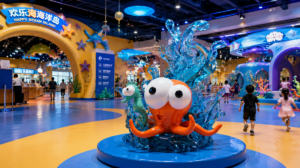
Discover how custom translucent resin ocean wave sculptures elevate ocean parks and playgrounds. Engineered for high-traffic commercial durability by Huizhou Xinyi Art.
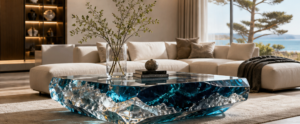
Discover the rise of resin art in modern interior design. Explore how custom resin furniture and epoxy art pieces are redefining luxury spaces with unique textures, durability, and artistic expression
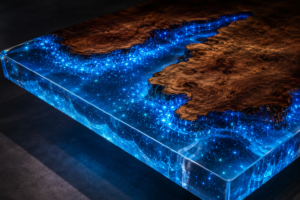
Discover how a professional source factory eliminates common defects like clumping and settling in illuminated and glowing resin furniture to deliver premium commercial projects.
 Huizhou Xinyi Art Co., Ltd.